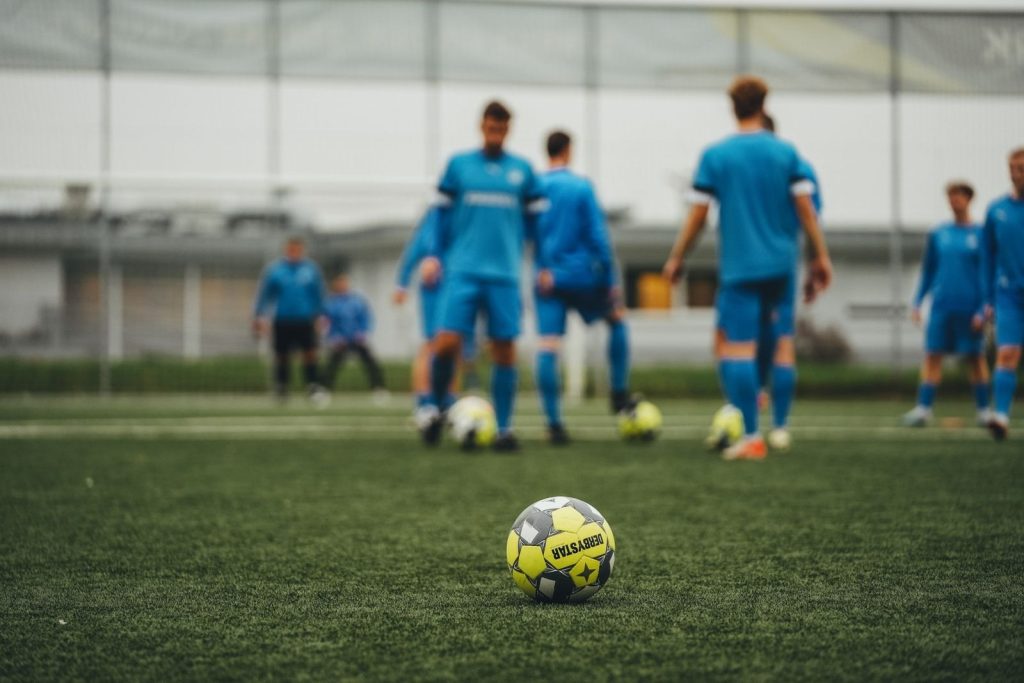

Readers often ask how to tell when a match has moved from one phase to another without relying on the scoreline alone. One reliable indicator is the height of each team’s defensive line, measured from the edge of their own penalty area. This measurement changes with the game state and reveals whether a side is inviting pressure, contesting midfield or protecting a lead.
Line height works alongside spacing between defenders and the distance to the midfield block. When these elements move together, the pattern points to a deliberate adjustment rather than random drift. Observers can track the line by noting where the deepest centre-back stands at the moment the ball is played forward from the opposition goalkeeper or central defender.
Baseline positioning at kick-off
Most sides begin with their deepest defender between 35 and 45 metres from the goal line when the opposition holds the ball in their own half. This distance allows cover behind the press while keeping the team compact enough to step up quickly. The exact starting height depends on the manager’s instructions and the opponent’s known preference for long balls or short build-up.
Early in the match both teams usually maintain this distance for the first ten to fifteen minutes. Any sustained deviation from the agreed height signals that one coach has already reacted to what they have seen. The change may appear first on one side only, creating an asymmetry that the other team can exploit.
Early elevation after sustained possession
When a team keeps the ball for several passages in the opposition half, the defensive line often creeps forward by five to eight metres. This step-up reduces the space behind the midfield and shortens the distance for quick recovery after turnovers. The movement is gradual rather than sudden, so it is easiest to notice by comparing the position at minute five with the position at minute twenty.
The elevation usually stops once the opposition begins to clear long or switches play to the opposite flank. If the line remains high after two or three clearances, it indicates the team believes it can win the second ball in advanced areas. Persistent high positioning without success often precedes a drop at half-time or after the first goal conceded.
Deliberate drop to protect a narrow lead
A side that takes the lead commonly instructs its deepest defender to retreat by ten to twelve metres once the clock passes the sixtieth minute. The retreat lengthens the distance the opposition must travel to create a chance and reduces the risk of being played in behind on the counter. The midfield block moves back in tandem, preserving the original gaps between units.
Viewers can confirm the intention by checking whether the full-backs also tuck in rather than stay wide. When the entire back four shifts deeper while the forwards remain high, the pattern shows a clear change from contesting to containing. This adjustment rarely reverses unless the team falls behind again.
Reactive push after losing the lead
Teams that concede while leading frequently push their line forward again within two or three minutes. The push aims to regain territory and crowd the opposition’s build-up before the new scoreline settles. The movement is faster than the earlier elevation and often uneven across the back line, with one centre-back stepping higher than the other.
Because the push is reactive, it can leave gaps between the centre-backs and the holding midfielder. Observers who note both the height increase and the sudden widening of those gaps can anticipate the next transition more accurately than by watching the ball alone.
Line height during sustained pressure
When one team dominates territory for ten minutes or more, the defending side’s line tends to oscillate between two heights rather than settle at one. After each clearance the line steps up briefly, then drops again once the ball is recycled. The amplitude of these oscillations narrows as the period of pressure lengthens, showing fatigue in the pressing triggers.
Eventually the deepest defender may remain five metres deeper than the starting position even after a clearance. This permanent drop signals that the defending team has accepted a lower block for the remainder of the spell. The change is clearest when compared with the height used in the first ten minutes of the same half.
Simultaneous observation of both sides
Useful reading requires checking both defensive lines at the same moment. When one side rises while the other drops, the distance between the two units shrinks and the tempo usually increases. When both lines move in the same direction, the match often slows because the team in possession faces a longer journey to goal.
Record the positions at natural breaks such as goal kicks, substitutions or injuries. These moments provide consistent reference points without interrupting concentration on the play. Over a full match the pattern of rises and drops usually aligns with three or four distinct phases rather than a continuous drift.
Limitations of the indicator
Line height alone does not explain why a team chooses a particular adjustment. Weather, pitch condition and the physical state of the forwards can produce similar movements without a tactical instruction. Cross-reference the height change with the width of the back line and the position of the holding midfielder to reduce misreading.
Some sides maintain a fixed height regardless of the score because their style is built around it. In those cases the absence of movement itself becomes the pattern worth noting. The method works best when applied to teams that have shown flexibility in previous matches rather than those with rigid structures.
Consistent tracking of line height therefore supplies a visible record of how each team interprets the evolving match situation. The record remains useful even when the final score does not reflect the balance of phases.